The Gift Effect: What Customers Say About Products They Buy as Presents
Consumer Insights




Every December, millions of products are bought by one person and used by another. When the box is opened, two people have expectations: the giver, who chose the product and paid for it, and the recipient, who has to live with it. Many of these products later get a review, and the review often says that the item was a gift.
These reviews are a small share of the total, but they carry a lot of signal. They tell brands which products people trust enough to give, what makes a gift feel special, and what turns a present into an embarrassment. The embarrassment can come from a crushed box, a return window that closed before the recipient opened the gift, or a warranty that ran out by spring.
To measure this, we looked at more than 11.3 million ratings and reviews collected from January 2023 to October 2026, across six industries:
In every industry, we compared reviews that mention buying or receiving the product as a gift with all other reviews.
The headline: about 1 review in 50 is a gift review. Gift reviews rate products higher, sound more positive, and arrive in a burst around Christmas. When they are negative, the complaints are ones brands can fix before the holiday rush.
Across all six industries, 236,000 of 11.3 million reviews (2.08%) say the product was bought or received as a gift. Two percent can sound like a niche. At the scale of an enterprise review base, though, it is tens of thousands of voices a year, and they are concentrated in the weeks that matter most for revenue.
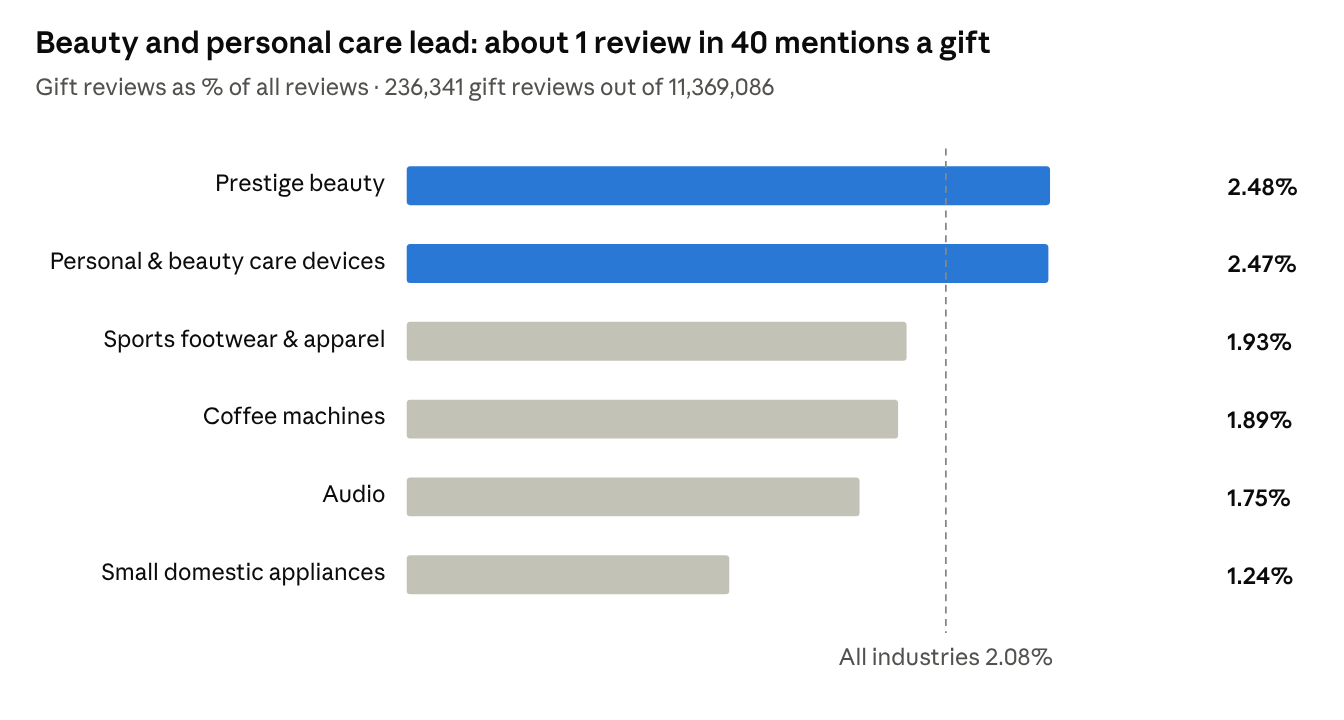
Gift share is highest where the product is personal, presentable and easy to wrap: skincare, makeup, shavers, hair stylers. It is lowest in small domestic appliances. That industry average hides big differences, though. Kitchen food-prep devices reach 3.2%, while floor care sits below 1%.
In every industry we studied, gift reviews carry a higher star rating than the rest. On average the gap is +0.26 stars (4.65 vs 4.39), and the Sentiment Index rises from 0.62 to 0.75.
Three forces seem to drive the uplift:
The gap is largest for grooming devices, where a shaver or hair styler given as a present scores up to half a star more than one bought for oneself.
It nearly disappears in two places:
If reviews were spread evenly, December and January together would hold 16.7% of a year's volume. Non-gift reviews come close to that. Across all industries, 25% of gift reviews land in those two months, compared with 17% of non-gift reviews.
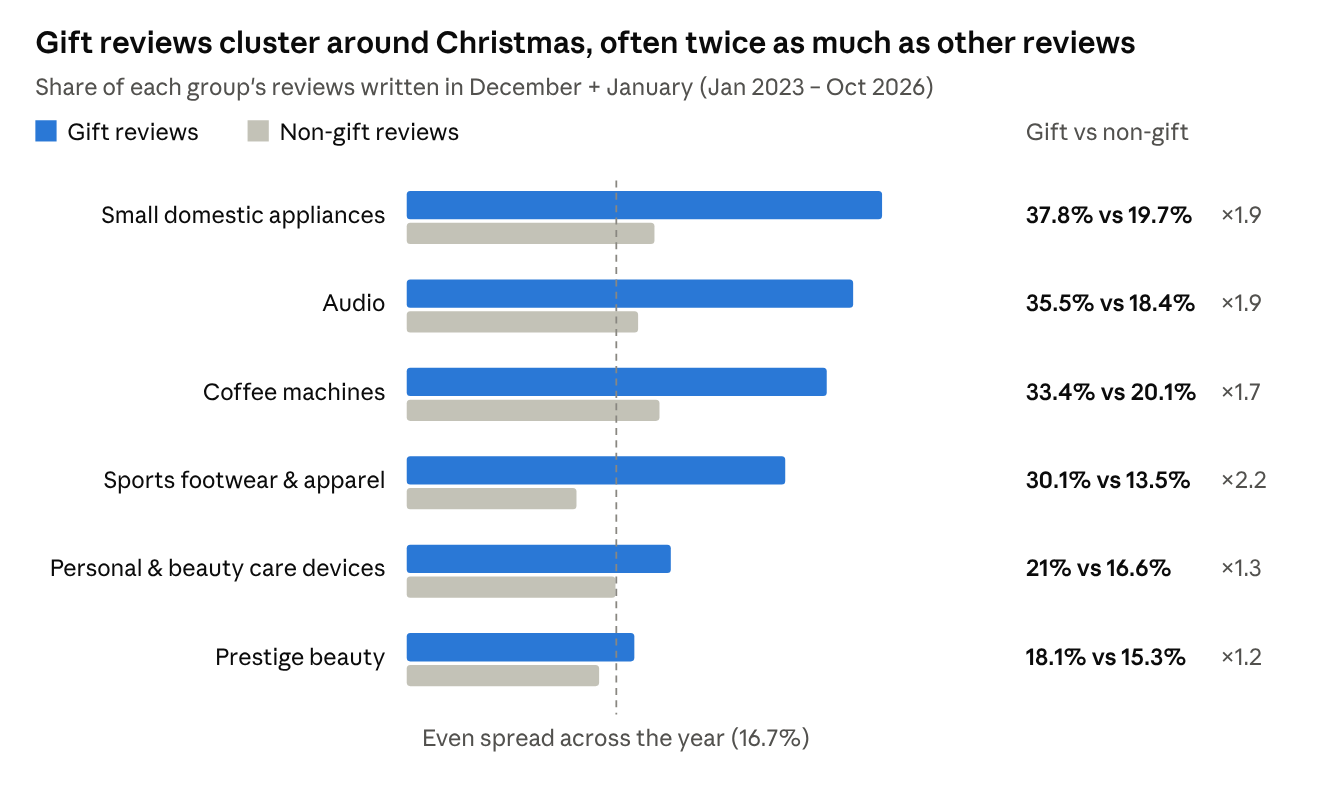
January, not December, is usually the peak. The gift is unwrapped on the 24th or 25th, used for a week or two, and then reviewed. This matters for planning. The reputation a product earns over the holidays shows up in ratings in the first weeks of the new year, which is also when shoppers start buying for themselves again.
Other cultural moments matter too:
One trend to watch: in several scopes, the share of gift reviews in December has been falling. Gifting has not necessarily declined, but the gift share of review volume is shrinking. Brands that want to hear from gift buyers and recipients may need to ask for those reviews more actively.
One pattern holds across all six industries: people give the product they would not hesitate to buy for themselves. Gifting favours premium, aspirational and well-known brands.
The most gifted categories are the ones that fit in a stocking and feel indulgent:
The luxury houses over-index strongly: Chanel (8.8%), SK-II (8.6%), YSL (5.2%) and Dior (4.9%). At product level:
Packaging and personalisation are part of the product. One reviewer wrote: "In luxurious packaging, I purchased as a gift for a friend and was able to personalise with her name."
Shaving is the most gift-dependent category in the whole study. Some 5.9% of shaving reviews mention a gift, 2.5 times the share of the rest of the portfolio. These reviews also rate highly: 4.86 stars, vs 4.50 for non-gift. Hair care follows (2.3–2.6%).
Specific brands of premium stylers dominate gifting:
Nespresso Vertuo is the clearest gifting platform in coffee:
Turkish coffee makers (4.6%) are also a popular local gift.
For brands, this is a customer-acquisition moment. A gifted machine creates a recipient who will buy consumables for years.
Headphones have a 2.6% gift share, compared with 1.7% for true-wireless earbuds. Party speakers sit at 0.7%. Apple products over-index above others:
Lifestyle sneakers has a 2.6% gift share, compared with 0.9% for Running. Lifestyle sneakers make good gifts. A technical running shoe that depends on gait and fit is a riskier choice for someone else.
KitchenAid stand mixers are the most gifted appliance in the study: Brand-level gift share of 8.1%
Other standouts:
Mid-priced value brands are rarely gifted.
The lesson is consistent across industries. Gift buyers pay for the emotion of a premium brand, so the brand's job is to make sure the experience lives up to it.
Gift reviews are more positive on average, but their negative reviews hurt more. A failed gift embarrasses the giver in front of someone they care about. It also tends to surface weeks or months after purchase, when the giver's usual safety nets have expired. Five complaint themes recur across industries.
1. Early failures, discovered late. Functional issues are the largest negative topic in gift reviews for appliances and coffee machines. The pain is in the timing: "Got this coffee machine as a present for my birthday… used it like 8 times and now this machine is broken."
2. Warranties and return windows that run out before the gift is used. A product bought in November may not be unwrapped until 25 December, and the recipient often does not tell the giver about a problem. One reviewer wrote: "I gave this as a Christmas gift in December 2024. It only worked a few months but the recipient did not inform me… It has now been more than 365 days." In beauty, the same problem appears with shades and scents: "I bought it as a gift, unfortunately it was the wrong color. I was not allowed to return it."
3. Ruined packaging and arrival damage. For a gift, the box is part of the product. Dented cartons, broken seals and missing parts appear in the gift reviews of every appliance and coffee scope we analysed. A product that is fine to keep for yourself can still be too damaged to give.
4. "It looked used": doubts about authenticity. In coffee machines gift reviews, about 2% say the machine felt second-hand: opened packaging, coffee residue, scratches. In beauty and premium audio, givers question whether a product bought through a marketplace was genuine. A gift that might be counterfeit can be worse than no gift at all.
5. Choosing for someone else. Wrong shoe size, wrong shade, wrong skin type, an earbud that does not fit. This is why gift reviews in prestige skincare mention more problems than non-gift ones, and why performance running shoes are rarely gifted. The giver lacks information that only the recipient has.
None of these complaints is about the product concept. All of them can be fixed through how the product is packed, sold, guaranteed and supported.
1. Extend return windows for the gifting season. Holiday purchases from early November should be returnable until at least the end of January, and say so on the product page and the receipt. Offer gift receipts, plus exchange-only returns for shade, size and scent, so recipients can fix a giver's guess without involving the giver.
2. Start the warranty when the gift is opened, not when it is bought. Let recipients register the product in their own name, and start or extend coverage from that date. A QR code inside the box ("Received this as a gift? Register it here") also gives the brand a direct line to a new customer.
3. Pack for the gift, not just for the trip. Audit Q4 shipping damage by SKU and channel, and strengthen outer cartons for the gift-heavy SKUs identified in your reviews. Test whether products can survive being shipped twice: once to the giver, once to the recipient. Where you can, offer ship-to-recipient with gift wrap and personalisation. In prestige beauty, personalised packaging appears in the most enthusiastic reviews.
4. Make authenticity visible. Use tamper-evident seals, authenticity codes or serial lookups, and a clear list of authorised retailers. Monitor marketplace sellers for refurbished or relabelled stock in the weeks before Christmas, and quickly answer reviews that suggest a product is used or fake. Givers need to trust that what they buy is new and genuine.
5. Help the giver choose. Gift guides, shade finders, size charts, "most gifted" badges and gift sets reduce the mismatch problem. Where the risk of choosing wrong is high, as with skincare, running shoes and earbuds, promote gift cards or exchange vouchers alongside the product.
6. Prepare support for January. Gift reviews peak after Christmas, not before. Staff customer care for the first weeks of January. Publish quick-start guides and setup videos for the most gifted products. Answer negative gift reviews quickly and offer a fix the recipient can claim without the giver. A replaced machine in January can turn a one-star review into a loyal customer.
7. Track gift reviews as their own segment. A simple keyword filter on review text ("as a gift", "Christmas present", "bought for my husband") is enough to start. Monitor the share, rating and complaint themes of gift reviews each week from November to February, and compare them with last year. They are the earliest sign of whether your holiday products are delivering on the promise the giver made.
Source and period. Ratings and reviews from Wonderflow dashboards, January 2023 to October 2026. Social media, video and forum sources were excluded where the original analysis required it.
Identifying gift reviews. We classed a review as a gift review when its text contains gifting expressions such as "as a gift", "gift for", "Christmas present", "birthday gift" or "gifted to". We excluded reviews containing incentivised-review language such as "gifted by", "complimentary", "free sample" or "in exchange for", which describes products sent for review rather than given as presents.
Metrics.
Wonderflow helps leading consumer brands transform unstructured feedback into actionable insights. Its AI Product Intelligence platform analyzes millions of online ratings, reviews, surveys, and customer comments, empowering teams to make smarter product, marketing, and customer experience decisions.
The AI platform that transforms customer feedback into actionable insights