What is Review Syndication and How Global Consumer Brands Should Approach It?
Ratings & Reviews



.png)

In global e-commerce, high review volume is often treated as quality. You might see a product on a major retailer’s site with 5,000 glowing reviews and think your market strategy is a home run. But you’re often looking at an echo chamber.
Review syndication is the practice where a single customer review is shared (or "syndicated") across multiple web shops, countries, and even different product variants. Retailers and brands use specialized platforms to distribute these reviews to ensure that new or low-selling products don't have "empty" pages, something often managed through broader consumer insights platform ecosystems. While this helps with merchandising and shopper confidence, it creates a major "Ghost Data" problem for the teams trying to analyze actual consumer sentiment.
Whether it’s an independent platform sharing reviews across global domains (like Shiseido.com to Shiseido.de) or a major marketplace like Amazon mirroring feedback across its country-specific sites, the result is the same: one customer voice is counted dozens of times, which is why many teams rely on customer insights software to normalize the data.
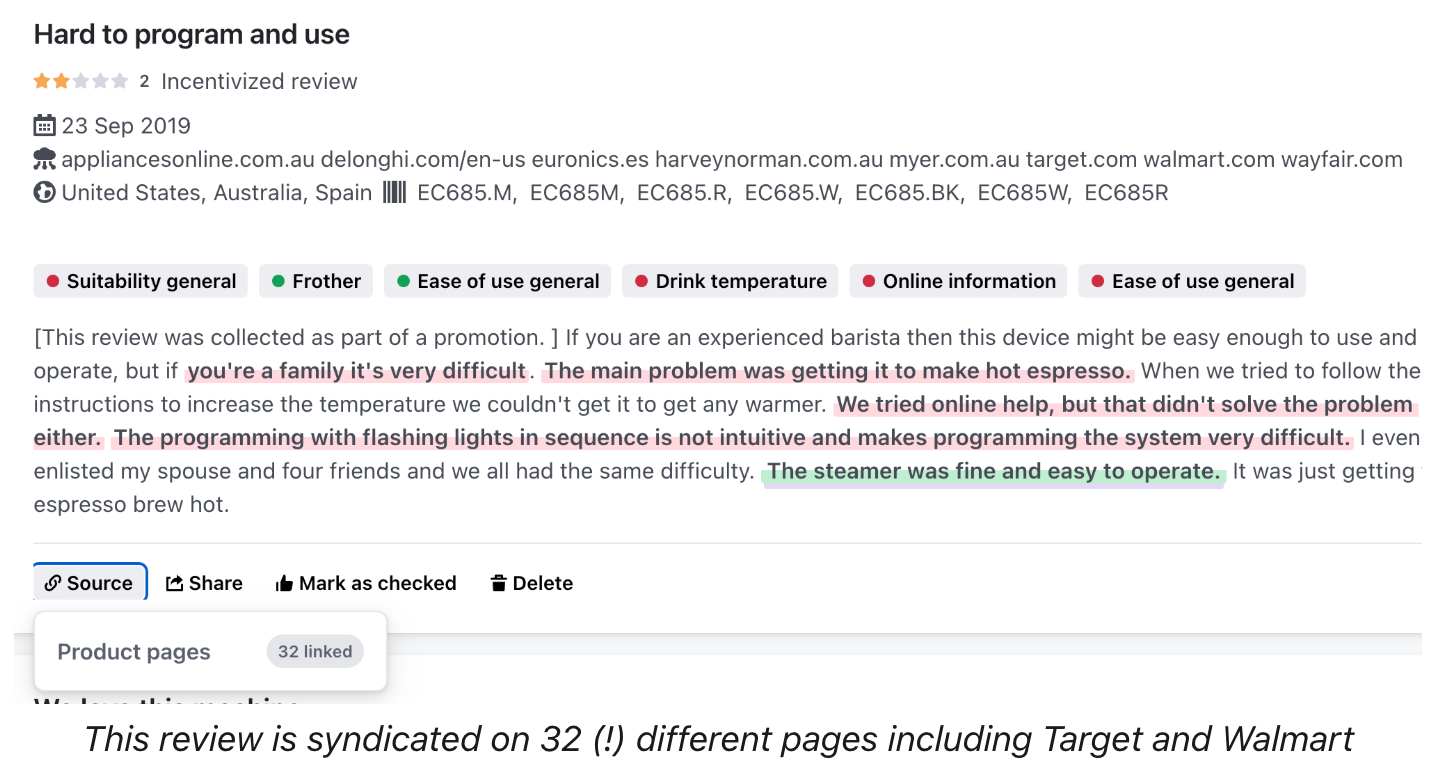
Webshops and brands use syndication primarily to solve the "cold start" problem. When a product page is empty, conversion rates plummet. Here is why they actively push for this shared data:
The Risk of "Dirty Data" in Your Strategy
While this is great for the retailer's conversion rates, it creates a problem for data quality. If your analytics team blindly trusts what appears on the page, they risk cross-contamination. You might end up analyzing feedback about a feature that doesn't even exist on the specific SKU you are currently tracking.
For a business leader, this creates a few problems:
A common but often overlooked form of syndication happens within the same webshop: Variant Syndication. To avoid "empty" product pages for new or low-selling items, retailers will "borrow" reviews from a similar version of the product.
For example, a customer might write a glowing review for a 1.5L Black Coffee Maker, specifically praising its capacity. The retailer then syndicates that review onto the page for the 1.0L White version, which creates issues that require AI for customer review analysis to detect.
If your VoC tool isn't "variant-aware," it will associate that praise for "large capacity" with the smaller model. This contaminates your SKU-level analysis and can lead to misguided product development decisions based on features that don't even belong to that specific model.
Pro-Tip: The "Blind Trust" Trap
Blindly trusting the reviews displayed on a product page creates "dirty data." To get a true understanding of how a specific SKU is performing, your system must be able to detect when a review belongs to a different variant than the one shown.
See how things are changing on Amazon here.
To solve the syndication puzzle, You need a system that understands the "DNA" of a review. Wonderflow’s customer sentiment analysis tools approaches this by first gathering every mention of your products across all global channels.
Because a single review can be syndicated across dozens of sites, our system is designed to perform a sophisticated "deduplication" process. Instead of seeing ten separate reviews, Wonderflow merges them into a single data point that preserves the history of where it has traveled.
How we maintain your data integrity:
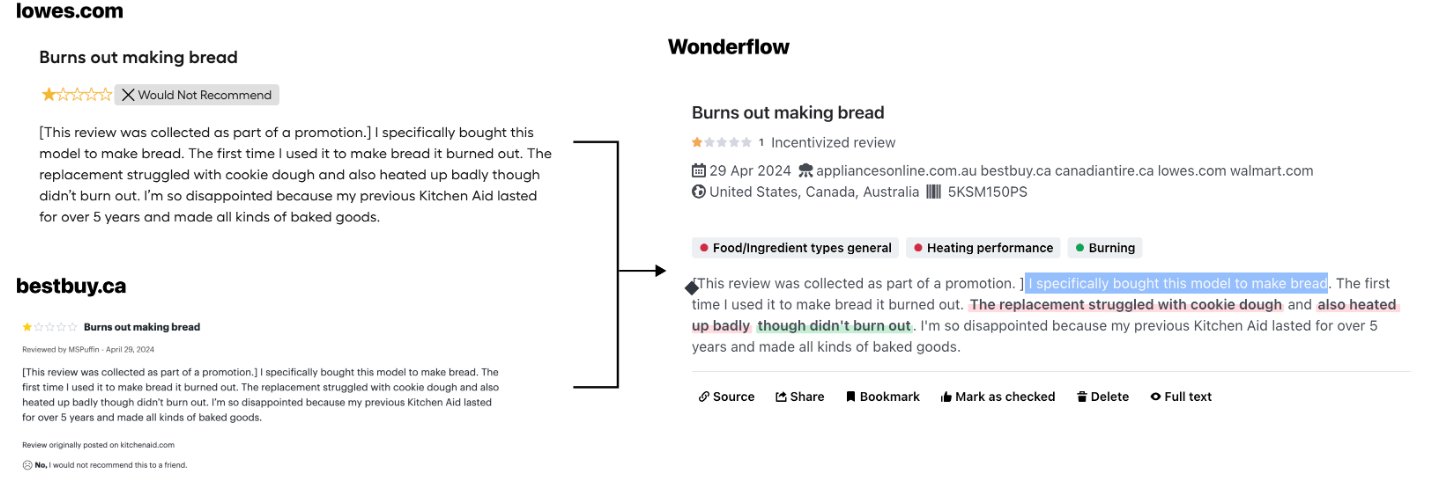
For a C-suite leader or a Product Head, the end goal is confident decision-making based on clean. By mastering review syndication, your organization gains a clear advantage:
In a world of digital echoes, Wonderflow ensures you hear the true voice of your customer, turning the maze of syndicated data into a clear path for strategic growth.
Wonderflow helps leading consumer brands transform unstructured feedback into actionable insights. Its AI Product Intelligence platform analyzes millions of online ratings, reviews, surveys, and customer comments, empowering teams to make smarter product, marketing, and customer experience decisions.


The AI platform that transforms customer feedback into actionable insights


.png)

.png)