MCP Connector: Bringing Wonderflow’s Product Intelligence to Your Favorite AI Workflows
Announcement



.png)

Building an agentic ecosystem inside an enterprise is no longer a future-state ambition. Product teams, commercial functions, and insights organizations are actively deploying AI agents to support decisions across the business. The decisions range from tactical execution like optimizing a product detail page, to strategic calls like determining how to enter a new market.
But an agentic ecosystem is only as valuable as the intelligence it can access. Most enterprise agents are well-designed and well-connected, except when it comes to customer intelligence. That data lives in a separate platform, requires a specialist to retrieve it, and rarely travels to where a decision is actually being made.
Wonderflow's MCP Connector changes that. It brings verified, enterprise-grade customer feedback intelligence directly into your workflows, whatever tool they run in, whatever team is using them, whatever decision is already in motion.
Every enterprise runs on more specialized tools than any single person can be proficient in. A brand manager who lives in Excel has a HubSpot moment every time they need to pull CRM data. A product manager fluent in Jira gets lost the first time they open a BI platform. Opening a tool you use twice a quarter and knowing exactly where to look are two very different things, and the cognitive load of navigating an unfamiliar interface is often enough to make the question not worth asking.
This is the quieter problem that agentic ecosystems are beginning to solve. When an agent has access to the right data sources, it acts as a proficient user of every tool it's connected to, on behalf of whoever is asking. The person asking doesn't need to be proficient with the platform, and doesn't need to remember which filter combination gets them to the answer they need.
Wonderflow's MCP Connector applies that same logic to consumer intelligence: the agent handles the expertise, the user handles the decision.
The Model Context Protocol (MCP) is an open standard that allows external AI agents, such as Claude, custom internal copilots, or spreadsheet-connected bots, to query external data sources in real time, without leaving the agent session. The Wonderflow MCP Connector implements this protocol as a secure, governed bridge between those agents and Wonderflow's proprietary intelligence layer.
When an agent queries Wonderflow via MCP, every insight it receives is fully traceable back to individual feedback records. This isn't a summarized output or a sampled dataset. It's structured, indexed intelligence that has already been processed and quality-checked before the agent touches it.
That means variant-aware analysis that distinguishes a packaging change from a formulation change. Structured metadata enrichment that tells you not just what customers said, but who said it and in what context. Discovery topics that surface granular signals beyond any predefined taxonomy. And Marketplace data that covers live category and competitor intelligence drawn directly from ecommerce, not from periodic surveys.
This is what separates a Wonderflow MCP query from asking a generic LLM to interpret a data export. The intelligence is already in the data.
Wonderflow's intelligence layer supports segmentation across hundreds of metadata fields: AI-extracted discussion topics, SKU-level attributes, market and channel breakdowns, customer type, and more. When an agent queries via MCP, that segmentation depth is fully available. A product manager can ask about a specific variant in a specific market over a specific time window and get an answer that reflects exactly that scope, not a blended average.
Connecting external AI tools to internal data raises an immediate question in any enterprise environment: who approved this, and what can it actually access?
The MCP Connector is designed to answer that question before it becomes a blocker. Access controls and data scope are fully customizable, and insights governance can be configured by team, by context, and by use case. Access is OAuth-protected via Wonderflow-issued credentials. The connector inherits your existing Wonderflow permission structure, so automated queries respect the same data boundaries as manual ones. Every request is tracked through Wonderflow's infrastructure for full auditability. Agents are strictly scoped to your licensed product catalog and cannot reach beyond the data you have configured and authorized.
The connector doesn't expose raw data. It exposes the same vetted analytical tools that power Wonderflow's own analytics engine, available to your agents via natural language. Your agents aren't retrieving numbers and interpreting them independently. They're executing validated analytical methods against verified data, and returning results that are consistent, repeatable, and ready for a decision.
You don't need to be a data scientist or learn complex API syntax. You talk to your agent in plain English, the same way you'd ask a question to someone on your insights team.
That means querying sentiment, topics, and trends without writing a single line of code. Asking things like "How many brands of vacuum cleaners are sold on Amazon in France?" or "What are the top complaints about noise for coffee machines?" and getting an answer back in seconds. And receiving results in both human-readable summaries and structured JSON, so you can build charts and visualizations directly from the output.
"The MCP Connector ensures that your external agents are no longer guessing, but are grounded in our verified data. We are moving toward a world where access to intelligence is regulated, secure, and infinitely more flexible."
Michele Ruini, Head of Product at Wonderflow
In each of these situations, a decision is already being made somewhere outside the VoC platform. The question is whether the right data makes it into the room in time.

Scenario: A brand or ecommerce manager is auditing product detail page copy before a relaunch. The claims on the page, "long-lasting battery," "easy to assemble," were written by marketing. Now someone needs to check whether real customers use that language, or whether what they actually describe tells a different story.
Use case: Mid-session in their content or AI writing tool, the manager queries Wonderflow's verified review data: "Do customers mention ease of assembly as a positive driver for this product?" or "What language do customers actually use to describe battery performance?" The answer comes back grounded in real feedback, not inferred from general product knowledge.
A PDP claim that contradicts what verified buyers say is a trust problem. It can also become a conversion problem.

Scenario: A brand manager is modeling pricing scenarios in a spreadsheet-connected AI agent. The commercial logic is sound, but one thing the revenue data doesn't show is how much price actually drives dissatisfaction for this product.
Use case: They query Wonderflow directly inside the model: "What percentage of negative reviews mention price as a driver for this SKU in this market?" The answer adds a signal that would otherwise require a separate request to the insights team, arriving too late to influence the recommendation already being written.
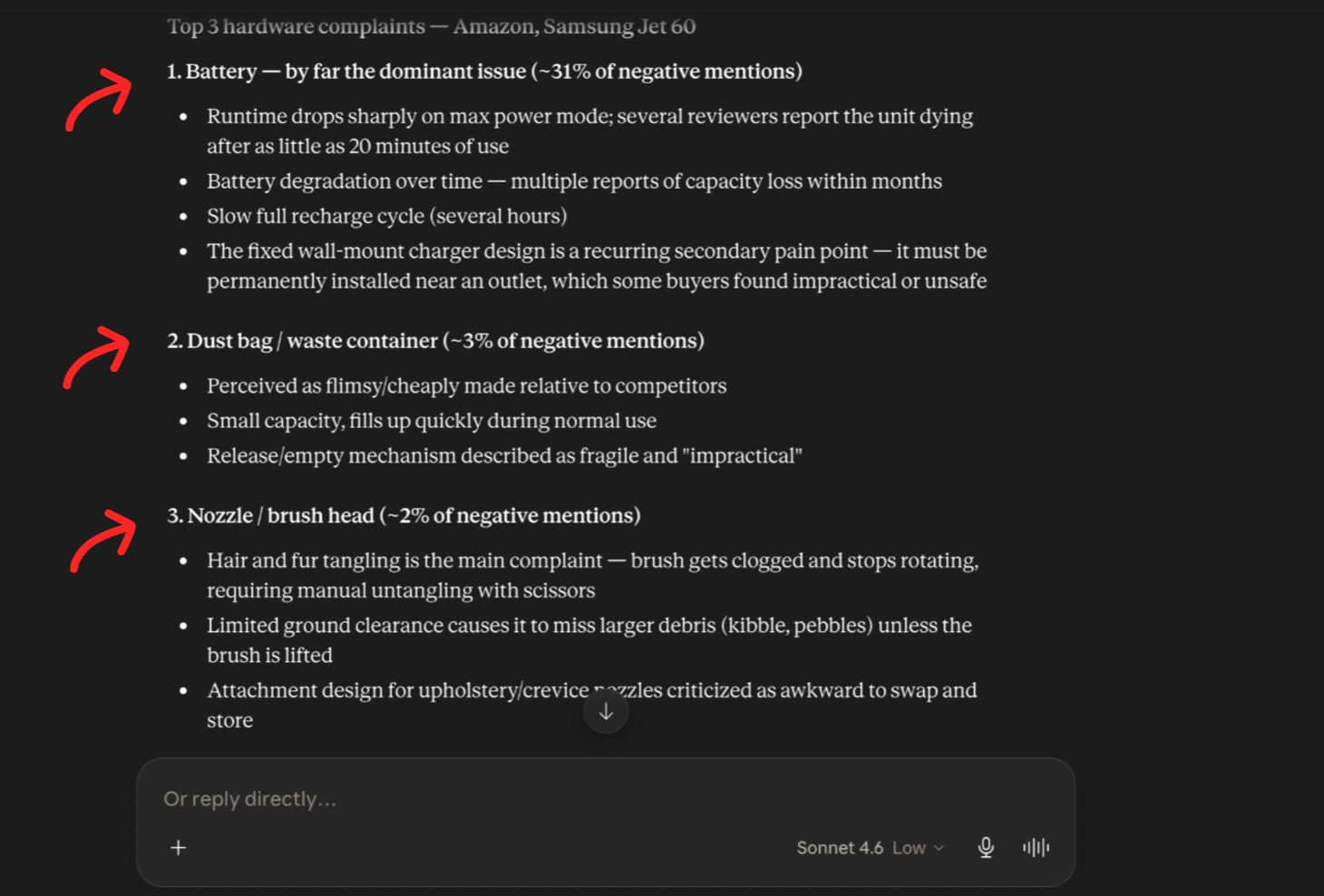
Scenario: During a monthly business review, a commercial team is working through SKU-level sales performance across markets. A product losing velocity in one region while holding in another raises an obvious question: is this a distribution issue, a pricing issue, or something customers are actually saying?
Use case: Rather than filing a request and reconvening next week, the team pulls Wonderflow's sentiment and feedback volume directly into the same session. What customers are saying becomes part of the conversation, not something the team circles back to later.
Over time, this changes how commercial and insights functions work together. The data handoff stops being a bottleneck because the data is already in the room.

Scenario: Sales flags an unusual return spike for a specific SKU in Germany. A product manager is already in their internal BI tool, looking at the numbers. The data confirms the spike is real. It doesn't explain why.
Use case: The usual next step is a request to the insights team: pull the feedback for this product, this market, this time window, variant-level if possible. That request joins a queue. The investigation stalls.
Instead, the product manager queries Wonderflow directly inside the BI session: "What are the top negative drivers for this SKU in Germany over the last 60 days?" The answer comes back scoped to the exact variant, traceable to verified feedback. The investigation stays in one place. The insights team gets involved when their judgment is needed, not to pull data.
Ready to see it in action? Book a demo and we'll walk you through how the MCP Connector works inside your existing workflows: https://www.wonderflow.ai/book-demo
Wonderflow helps leading consumer brands transform unstructured feedback into actionable insights. Its AI Product Intelligence platform analyzes millions of online ratings, reviews, surveys, and customer comments, empowering teams to make smarter product, marketing, and customer experience decisions.


The AI platform that transforms customer feedback into actionable insights