How Wonderflow Uses High-Resolution Topic Extraction to Uncover Hidden Consumer Signals
Feedback Analysis



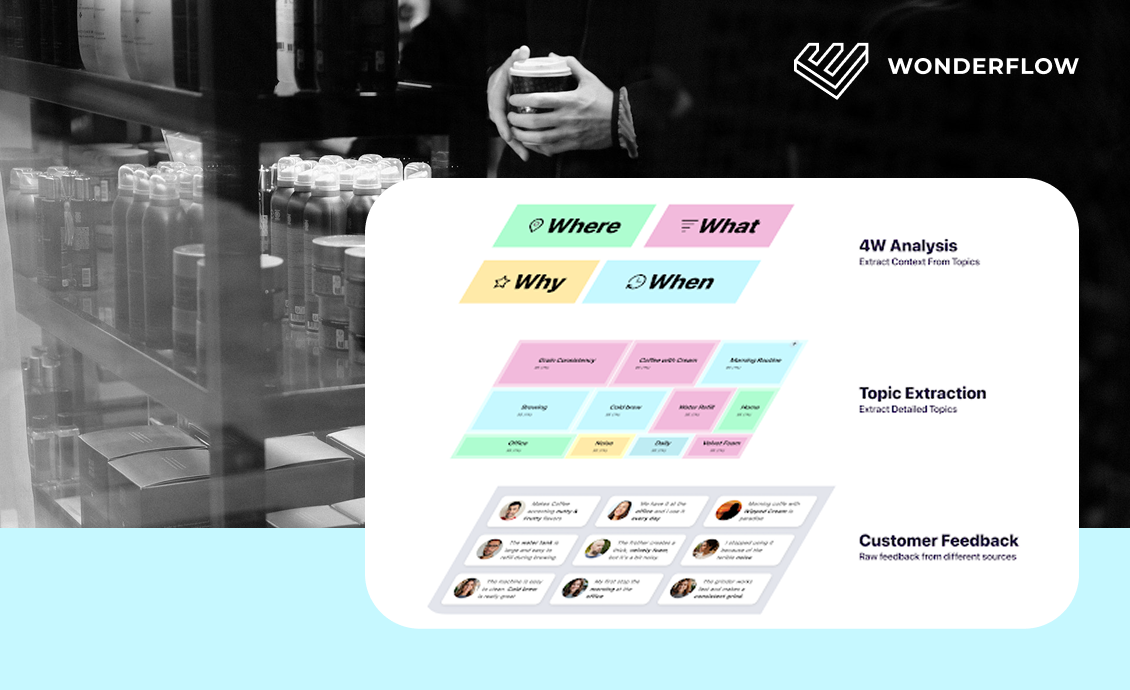

Wonderflow has moved beyond standard data processing into a new era of high-resolution product intelligence. Discovery Analysis represents the next evolution of our product intelligence platform, enriching customer feedback with thousands of LLM-extracted topics that are automatically cleaned, normalized, and indexed.
Rather than relying on a fixed set of categories, this innovative layer allows brands to explore feedback with unprecedented depth, offering a flexibility that was previously unreachable.
This feature doesn't just summarize data; it illuminates the "fine-grained" signals that define the modern consumer experience.
The true innovation of Discovery Analysis lies in its ability to go beyond simple topic identification. By leveraging advanced LLM capabilities, Wonderflow enriches every extracted topic with a secondary layer of intelligence: the 4W Context Framework.
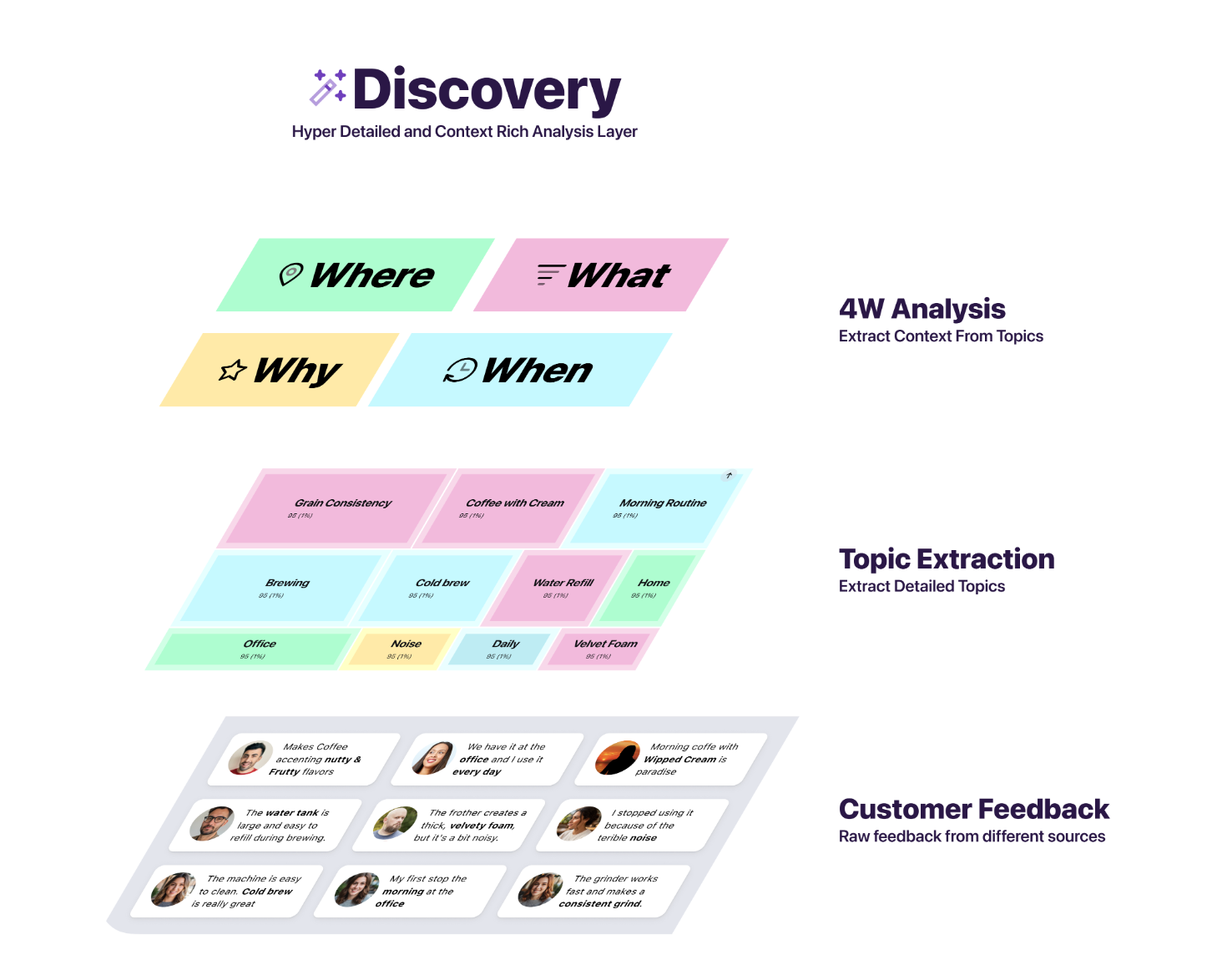
This framework transforms a data point into a narrative by identifying the specific circumstances surrounding customer feedback. While traditional sentiment analysis might tell you what a customer thinks, the Discovery Layer explains the environment in which that opinion was formed — something the best sentiment analysis tools have only recently become capable of at this level of granularity.
By structuring data this way, Wonderflow enables hyper-segmentation. A Brand Manager doesn't just see "negative sentiment for a coffee machine"; they see that "water is dripping from the bottom (Where) during the first use (When) because of a large opening (Why)".
This level of detail is directly consumable via interactions with Wonder Agents, providing a traceable and consistent foundation for every business decision.
In the world of artificial intelligence, an agent is only as good as the data it can access. While generic AI assistants often struggle by "hallucinating" or summarizing unverified, raw text, Wonder Agents operate on a fundamentally different principle: they are powered by the Discovery Analysis layer.
This layer serves as the "Engine Room" for Wonderflow’s Agentic AI. Instead of just searching for keywords, our agents navigate a structured, validated intelligence layer that has already been indexed and quality-checked.Every result returned by a Wonder Agent is traceable back to the specific metrics and feedback records identified in the Discovery Layer. This removes the "black box" nature of AI, ensuring that insights are repeatable and auditable.
"Wonder Agents provide a controlled way to operationalize AI across an organization without turning analytics into an opaque black box. Every insight is transparent, repeatable, and traceable." — Gianluca Ferranti, CEO, Wonderflow
Discovery Analysis is a core intelligence layer that powers new, high-stakes use cases across the enterprise. By adding to a fixed ontology a fluid, LLM-extracted model, brands can now address questions that were previously too complex or time-consuming to answer.
Rather than replacing your existing frameworks, Discovery Analysis acts as a high-definition multiplier for your current data strategy. Standard Analysis remains the best choice for KPI monitoring. Because it uses industry-specific dictionaries, it ensures total consistency over time, which is essential for long-term benchmarking and metric setting. Discovery Analysis is your tool for exploration and depth. It is where you go when you need to "break the glass" on a metric to see the thousands of fine-grained signals living underneath it.
Think of it this way: Standard Analysis is your reliable compass for tracking the health of your brand, while Discovery Analysis is the high-powered microscope inside your customer insights software used to diagnose the "why" behind every metric movement.
Wonderflow helps leading consumer brands transform unstructured feedback into actionable insights. Its AI Product Intelligence platform analyzes millions of online ratings, reviews, surveys, and customer comments, empowering teams to make smarter product, marketing, and customer experience decisions.


The AI platform that transforms customer feedback into actionable insights