7 Questions to Ask Any "AI-Powered Insights" Vendor Before You Commit
AI



.png)

The market is flooded with platforms claiming to turn customer feedback into actionable intelligence.
Before you sign a contract, here are seven questions that separate genuine consumer intelligence from a well-dressed dashboard.
Most vendors handle the easy part: NPS, CSAT, surveys. Your internal data is structured and already yours. Ingesting it is a solved problem.
The harder question is what they can do with unstructured, public signal you don't control: webshop reviews across hundreds of global retailers, social platforms, community forums, video reviews. Find out whether they own their collection infrastructure or depend on third-party aggregators. A vendor relying on a reseller has no control over coverage gaps, source changes, or your ability to add a channel when you need one.
The brands that pull ahead aren't the ones with the best NPS dashboards. They're the ones hearing what customers say when no one's asking them a question.
.png)
Ask for specifics: which webshops, in which markets? Which social and community platforms: forums, Reddit, video reviews? The breadth gap between vendors is enormous and rarely visible in a demo. A platform strong on Amazon but blind to regional retailers in Germany, Southeast Asia, or Latin America gives you a distorted view of your global consumer.
The same applies to social: discussion data from communities and forums captures product sentiment that never makes it into a star rating. Ask whether these sources are treated as first-class inputs in the analysis, or just appended as an afterthought.
Most platforms treat a product line as a single entity, pooling reviews for every size, color, or formulation into one consolidated score. That works for a marketing dashboard. It is a bottleneck for product development and CMI teams.
Ask whether the platform can distinguish between cosmetic differences, like a packaging color change, and functional ones, like an ingredient reformulation or a fit adjustment. A serious platform should not force you to navigate generic filters or guess which SKU caused a sudden dip in sentiment. If it cannot isolate feedback down to the exact variant a customer experienced, you are looking at a blurry average, not product intelligence.
Sentiment analysis has existed for 15 years. The question isn't whether a vendor uses AI, but what kind and for what purpose. Ask whether their analytics layer is purpose-built for product intelligence, or a generic LLM with a label on top.
Ask whether their topic extraction goes beyond predefined taxonomies, and whether it can surface granular, context-rich signals that no manual ontology would capture. A platform trained on VoC data performs differently from one retrofitted for it, and that difference shows up immediately in the depth of what you can actually ask on a purpose-built product intelligence platform.
Also ask whether you need to manually tag the drivers, or whether the platform has a structure to surface signals from the data itself.
Summarization is easy. The harder problem is turning unstructured feedback into structured, segmentable intelligence: who the customer is, how they use the product, and how often. Ask whether the platform applies AI metadata enrichment with quality-controlled outputs: structured classes designed for your industry, not free-form LLM generation. Without that, you're reading digests rather than doing analysis.
Every vendor now has an AI assistant. The right question isn't whether they have one, but what it's grounded in. Generic AI agents answer from the internet or from raw text. Ask whether their agents operate on indexed, validated, proprietary data, and whether every output is traceable back to real feedback. An agent that can hallucinate is not an enterprise analytics tool. The best AI sentiment analysis tools ground every output in verified, traceable data.
Traditional market research tools give you coverage where they have panels. For categories, geographies, or emerging competitors outside that scope, you're blind. Ask whether the platform can give you live market intelligence: products, brands, ratings, pricing trends, drawn directly from ecommerce, not from periodic surveys. The ability to explore a category you don't yet play in, or track a competitor you didn't know existed, is what separates reactive from proactive product strategy.
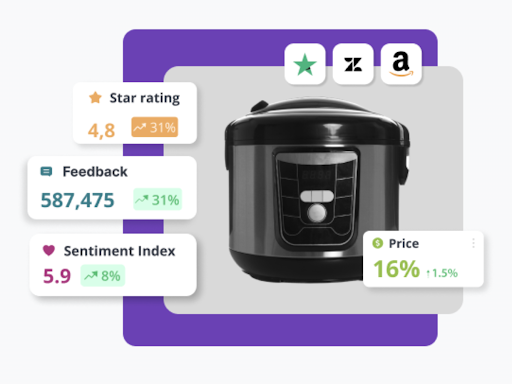
At Wonderflow, we've built our platform to answer these questions, thanks to:
If you want to put us to the test, we're ready. Book a demo with our team today.
Wonderflow helps leading consumer brands transform unstructured feedback into actionable insights. Its AI Product Intelligence platform analyzes millions of online ratings, reviews, surveys, and customer comments, empowering teams to make smarter product, marketing, and customer experience decisions.


The AI platform that transforms customer feedback into actionable insights